
Plan it: How to Book a Yacht Charter in Croatia – Step-by-Step Guide
Every winter the same question arrives in our inbox. Should we take a catamaran or a monohull? Both look right in the photos. Both are right for someone.
The real question is who is coming. How old they are, how they feel on the water, how much they want to sail and how they want to spend the evenings. Answer that first and the boat usually chooses itself.
What a catamaran gives you, and what it costs
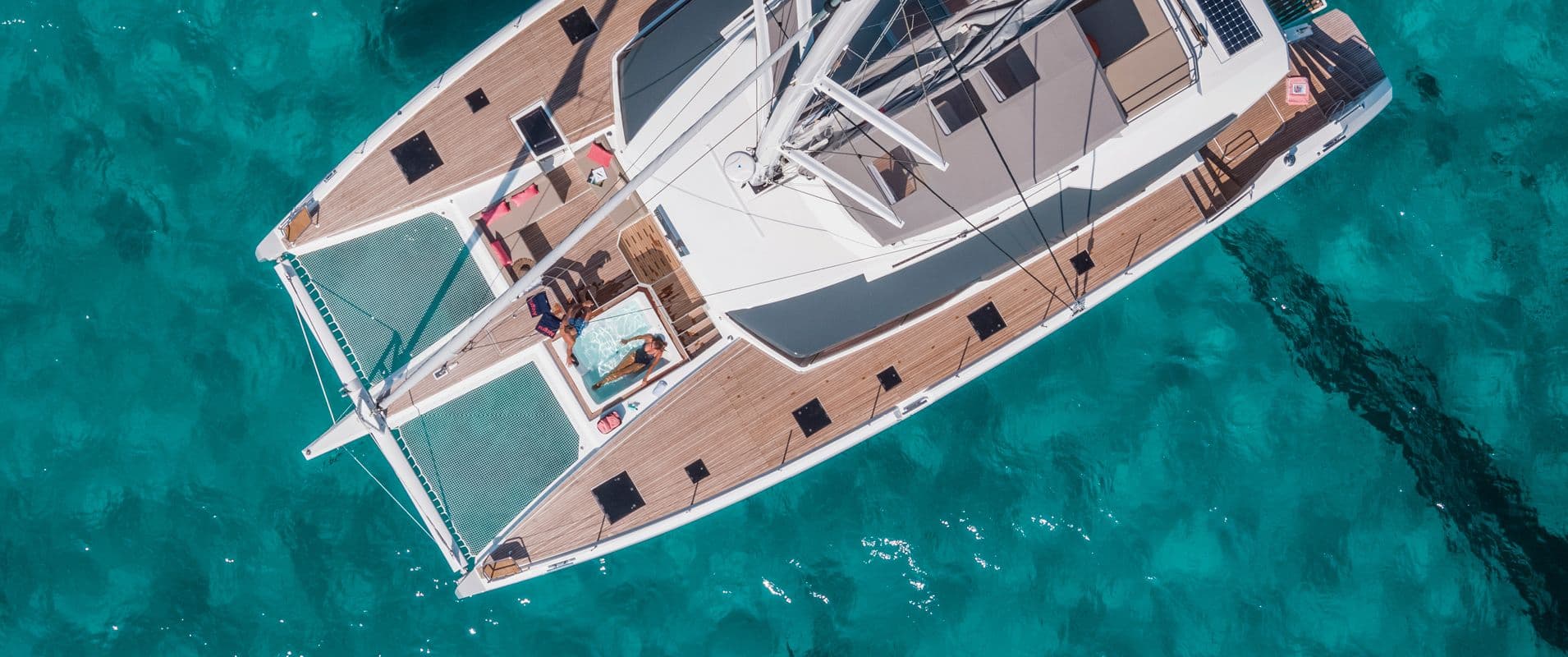
A catamaran sits on two hulls and barely heels. A cup of coffee left on the saloon table is still there an hour later. For many groups that changes the whole week.
- Space on one level. The cockpit and saloon join up, so whoever is cooking is not cut off from the conversation.
- Privacy. The cabins are split between the two hulls. That suits two or three couples, or parents who want some distance from their teenagers.
- Calm at anchor. A catamaran rolls less in a swell. Nights in an open bay are usually quieter.
- Shallow draft. You can anchor closer to shore in sandy bays and swim straight off the back.
The trade-offs are real. A catamaran is wide, and most Croatian marinas charge more to berth one than a monohull of the same length. Two engines burn more fuel. The weekly charter price is usually higher for the same number of berths, so compare the price on each boat card rather than assuming. In late July and August, finding a gap on a busy town quay is harder with a wide boat.
Catamarans also sail less well towards the wind. On a maestral afternoon, heading back up the Brač Channel towards Split, many catamaran crews give up and motor.
What a monohull gives you, and what it asks
A monohull heels, leans into the wind and answers the helm. In a steady maestral it is the reason sailors come to Croatia. It sails closer to the wind, so you spend more of the week under sail and less on the engine.
- Lower cost. For the same number of berths, a monohull usually charters for less. Its marina fees and fuel bill are usually lower too.
- Easier berthing. A narrower boat fits into more town quays and smaller harbours.
- The feel of sailing. If anyone aboard wants to learn, trim sails or take the helm in a breeze, this is the boat.
What it asks is a tolerance for living at an angle while under way. You step down into the saloon, which has less light. Aft cabins often share a wall, and space is tighter for a large group.
A note on seasickness. Neither boat cures it. A monohull heels but moves slowly. A catamaran stays flat but can jolt in a short, steep chop, the kind a jugo can bring. People who suffer tend to do better on whichever boat lets them stay on deck and watch the horizon.
Who is aboard decides it
Look at your list of names, not at the deck plan.
- Young children or older relatives: lean towards a catamaran. The decks are flat and there are fewer steps. Keep an eye on small children near the nets at the bow.
- Experienced sailors who want to sail: lean towards a monohull.
- Two or three couples on an easy week: a catamaran's separate hulls and shared cockpit are hard to beat.
- A group watching the total budget: a monohull. Count marina fees and fuel as well as the charter price.
- A mixed group: decide what matters most on a calm evening at anchor, because that is most of the week.
If nobody aboard holds a skipper's licence, that does not narrow your choice. We can add our own skipper to a bareboat of either type for whole weeks, and a cook as well. If someone in your group will skipper, the charter company checks their licence and VHF certificate at check-in. On a crewed yacht, the charter company's crew comes with the boat.
Once you know who is coming, open the boat search on our site and filter by boat type and number of cabins. Or send us a quote request with your dates. We reply by email within minutes with the boats free for those dates, each checked live, followed by route ideas. A person answers your replies.