
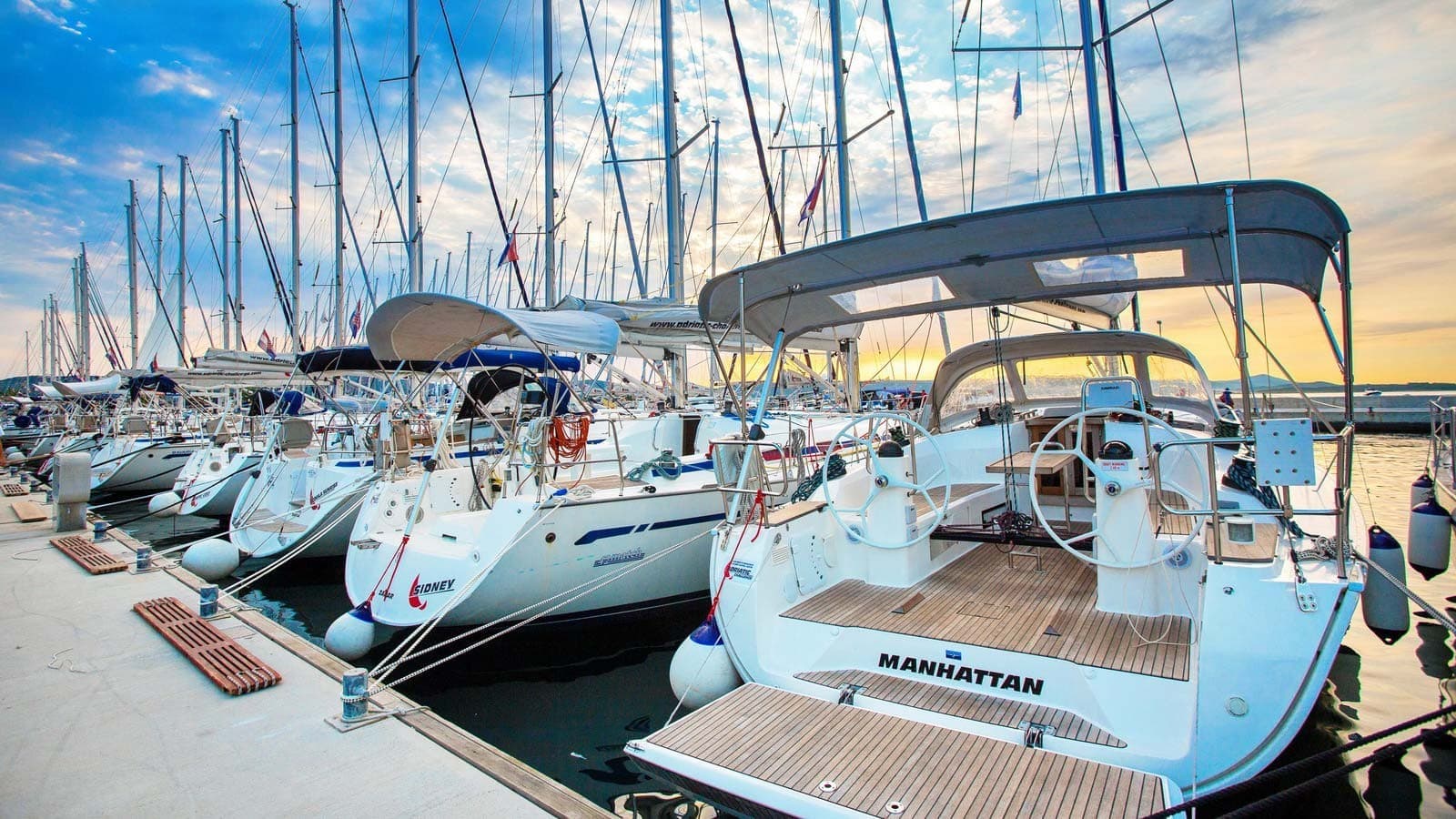
When you picture your charter in Croatia you probably imagine bays, islands and anchorages. In reality, marinas and harbour walls shape a big part of the week too – especially the first and last nights. They are where you meet the boat, solve small problems, refuel, buy ice and say goodbye. Understanding how Croatian marinas work makes the whole trip calmer.
This guide is written from the skipper’s side of the pier. It explains what a typical charter base looks like, how check-in really works on Saturday, when you should plan to use marinas during the week and when a town quay, buoy field or anchorage is a better choice. If you are still deciding where to start, you can always jump to the Croatia overview or the main Destinations hub. Here we stay focused on the marinas themselves.
Why Marinas Matter on a Croatian Charter
On most weeks you will spend two to four nights in marinas or on town walls and the rest at anchor, on buoys or on simple jetties in front of small konobas. Marinas are where you:
- Meet the charter team and do the technical handover.
- Take on water, plug into shore power and charge everything fully.
- Do the big supermarket run and organise airport transfers.
- Refuel and complete checkout at the end of the trip.
- Enjoy one or two evenings with easy showers, restaurants and a short walk into town.
Knowing this in advance helps you design a week that balances “marina nights” with quieter stops. Some crews like comfort and choose more marinas, others prefer bays and only come back to the base when they must. Both approaches are fine if planned consciously.
Types of Marinas & Harbours You Will Use
In Croatia you will see three main flavours of places where yachts tie up:
- Big marinas: Purpose-built facilities with long pontoons, reception, showers, Wi‑Fi, laundry and often shops and restaurants. Many charter fleets in Split, Trogir, Zadar, Dubrovnik and other hubs are based here.
- Town harbours and local marinas: Smaller harbours run by the local authority or a local company. You moor on the quay or to short piers right beside the old streets.
- Private jetties and konoba piers: Simple wooden or concrete jetties belonging to a restaurant or small business. You pay by eating dinner, sometimes with a small extra fee for water or power.
This page focuses mainly on the first two, but we will also touch on mooring fields and anchorages so you can see the full picture.
What to Expect from a Typical Croatian Marina
While each marina has its own character, the layout is usually familiar: reception near the entrance, a line of pontoons or quays with mooring lines, a service zone with fuel dock and technical workshops, and facilities blocks with showers and toilets. Many larger marinas also have small supermarkets, cafes, charter offices and sometimes hotels or pools.
Mooring is usually stern-to with laid lines: you approach slowly, drop the stern lines to the quay and then walk a mooring line forward to the bow. Marinero staff in small ribs often guide you in and help with lines on busy days. If you are hiring a local skipper or booking with crew, they handle this for you; otherwise, the charter base will explain the routine at check-in.
Arrival Day at the Charter Base
On Saturdays Croatian marinas around major charter hubs are busy but surprisingly well organised. A typical rhythm looks like this:
- Late morning / early afternoon: You arrive at the marina, leave luggage at the charter office and park the car or meet your transfer.
- Midday: One part of the crew does the big provisioning run while others explore the town, swim by the marina beach or sit in the shade with coffee.
- Afternoon: When the technical staff finish cleaning and checks, the base calls you for the handover. Together you go through systems on board, note any existing cosmetic damage and confirm that safety gear is complete.
- Late afternoon / evening: Depending on paperwork, weather and your energy levels, you either stay in the marina or make a short first hop to a nearby bay.
The exact timing depends on how quickly previous crews return on Friday, how many small repairs were needed and on the general Saturday traffic. Having realistic expectations – and a plan for how to spend a few hours ashore – keeps everyone relaxed.
Leaving the Marina – First Evening on the Boat
Many skippers choose a gentle first move: a one- or two-hour hop to a nearby bay or town. It lets you get used to the boat without pushing against sunset, and gives the crew a taste of being at anchor right away.
Others prefer to stay in the base marina for the first night, especially if they arrive late or if there are families with small children who appreciate showers, restaurants and good lighting. There is no right or wrong choice – it depends on your arrival time, the weather and how the crew feels after travelling.
Using Marinas During the Week
During the week you are free to choose where you sleep each night as long as you respect the agreed Friday return time. Most crews mix options. A simple pattern that works well is:
- 1–2 nights in full-service marinas with showers, laundry and restaurants.
- 1–2 nights on town quays in smaller places where you are steps from the old streets.
- 2–4 nights on buoys, simple jetties or at anchor in bays.
When planning, look at your route and choose marinas on nights when you want to stretch your legs, recharge batteries or give children time to explore a town. On very hot or windy days, a marina with a pool or sheltered promenade can be a welcome breakpoint.
Mooring Fields, Town Quays & Anchorages
Alongside marinas you will see many other places where yachts gather.
- Mooring fields: Buoy fields in front of a village, beach or restaurant. You pick up a buoy line from the bow and sometimes also tie the stern to shore. Often a small boat comes to collect a fee and help with lines.
- Town quays: Stone walls where you moor stern-to with mooring lines or your own anchor. They put you right in the centre of the town, with electricity and water on many quays.
- Anchorages: Bays where you simply drop anchor and swing. Some are free; others have small charges for waste collection or park tickets.
Good weeks use all three. This marinas page helps you decide when you really want a full-service stop and when something simpler is enough.
Regional Overview – Main Charter Marinas by Area
The exact marina names are less important than understanding the pattern by region. For deeper local flavour you can open the dedicated guides for Zadar, Šibenik, Split, Trogir, Dubrovnik, Istria and Kvarner.
- Northern regions (Istria & Kvarner): Pula's marinas and Punat on Krk hold nearly all the northern fleet; Rovinj, Cres and Lošinj are harbours to sail to, with smaller town harbours dotted along the coast.
- Zadar & Šibenik area: Several big marinas close to the towns (plus large bases like Biograd and Sukošan) serve fleets heading to Kornati and nearby islands.
- Central Dalmatia (Split & Trogir): The densest concentration of charter boats, with multiple marinas around the cities and on nearby islands.
- Southern Dalmatia (Dubrovnik): Almost the whole fleet at ACI Komolac, just outside the city, plus town quays and moorings throughout the Elaphiti and Pelješac area.
When you search boats through SkipperCity’s Boat Search tool, each offer clearly states the home marina so you can factor this into your travel plans.
The main charter marinas, north to south
| Marina | Area | Why it matters |
|---|---|---|
| Marina Punat | Kvarner, Krk | Biggest northern base; reachable by road |
| ACI Marina Pula / Marina Veruda | Istria | The Istrian fleet |
| Marina Kornati, Biograd | Zadar / Kornati | One of the biggest charter bases in Croatia; the closest big base to the Kornati |
| D-Marin Dalmacija, Sukošan | Zadar | One of the largest in the Adriatic, 12 km south of Zadar |
| Marina Hramina, Murter | Šibenik / Kornati | Closest base to the national park |
| Marina Frapa, Rogoznica | Šibenik | A large marina with full facilities, right on the water at Rogoznica |
| D-Marin Mandalina | Šibenik | Superyacht berths behind a sheltered channel |
| Marina Kaštela | Split | One of the biggest charter bases in Croatia, 10 min from the airport |
| Marina Baotić / SCT Trogir | Trogir | Big fleets beside a UNESCO old town |
| ACI Marina Split | Split | In the city, walk to Diocletian's Palace |
| ACI Marina Dubrovnik | Dubrovnik | The southern base; 6 km from the Old Town |
Most charters described as "Split" leave from Kaštela, Seget or Trogir — all within 20 minutes of Split airport. Check which marina your booking names before you book anything ashore.
Fuel Docks, Water, Power & Facilities
Fuel docks are usually located inside or just outside the marina entrance. On Friday afternoons you will see a line of charter boats waiting to refuel before returning to their berths. Your skipper or base will tell you whether they prefer you to refuel on your own or together with a base technician.
Water and shore power points are located along the pontoons and quays. In full-service marinas they are robust and plentiful; in small town harbours they may be more basic or limited to certain stretches of quay. Showers and toilets are normally clean and well maintained, especially in marinas that handle many charter boats.
Other facilities you often find in marinas include laundry machines, small chandlery shops, boat maintenance services, Wi‑Fi, ATM machines and sometimes car rental desks. The marina's own website lists its services, so check it before you plan around a laundry or a fuel dock.
Prices, Reservations & Practical Tips
A night in a Croatian marina in high season costs about 55–110 € for a 45 ft monohull and 90–180 € for a 12 m catamaran, because berths are priced by length, and a catamaran pays a surcharge, typically one and a half to two times the monohull rate. Town quays are slightly cheaper, mooring buoys in a bay cost 25–60 €, a konoba's buoy is often free if you eat ashore, and anchoring is free. May and October run roughly a third lower.
Marina prices vary by region, season and boat size. As a rule of thumb, full-service marinas cost more than town quays, and town quays cost more than buoys or simple anchorages. Catamarans usually pay a higher fee than monohulls of similar length because they occupy more beam.
In high season it is sensible to reserve marina berths in the most popular spots, especially if you plan to arrive later in the afternoon. Outside of peak weeks you can often decide on the day, calling the marina office on VHF or phone around lunchtime to see what is available.
A few small habits make life easier:
- Arrive earlier in the afternoon if you want choice of berths and more time for showers and town walks.
- Have fenders ready on both sides and mooring lines prepared before entering a busy marina.
- Keep boat documents and crew list handy – reception may ask to see them at check-in.
- Ask clearly which services are included (water, power, showers) and which are extra.
- In peak weeks, consider using more buoys and anchorages and fewer marinas to avoid the biggest crowds.
A night afloat, high season
| Where you tie up | 45 ft monohull | 12 m catamaran |
|---|---|---|
| ACI or D-Marin berth | 70 – 110 € | 110 – 180 € |
| Smaller private marina | 55 – 90 € | 90 – 150 € |
| Town quay | 55 – 95 € | 90 – 150 € |
| Mooring buoy in a bay | 25 – 45 € | 35 – 60 € |
| Konoba buoy with dinner ashore | often free | often free |
| At anchor | free | free |
Water and electricity are normally included in a marina berth and metered on a town quay. A week mixing three marina nights with three at anchor or on a buoy is the usual compromise — and it is roughly 400 € cheaper on a monohull than a week of marinas.
Friday Return & Checkout Routine
Most Croatian charters require you to be back in your home marina by late Friday afternoon, sleep on board and check out on Saturday morning. The classic pattern looks like this:
- Friday morning: Breakfast and last swim somewhere close to the base.
- Midday: Sail or motor back towards the home marina, leaving enough margin for wind, queues and fuel dock traffic.
- Afternoon: Refuel, return to your berth and complete the technical checkout with the base. Afterwards, you are free to shower, pack, and enjoy one last evening in the marina or nearby town.
- Saturday morning: Final packing and formal checkout, then taxi, transfer or car heading home or to your next stop.
Planning this calmly – without trying to squeeze in a long final sail on Friday – is one of the best gifts you can give your future self.
FAQ – Croatian Marinas for Charter Guests
How many nights will we spend in marinas?
On a typical one-week charter most crews spend between two and four nights in marinas or on town quays and the rest on buoys or at anchor. If you want more comfort or travel with very young children, you might choose more marina nights; if you want a wilder feel, you can choose fewer. Reply to our quote emails and a person helps you find the balance for your crew.
Do we have to stay in the home marina on the first and last nights?
You almost always stay in the home marina on the last night, because of refuelling and checkout. On the first night it depends on arrival time, weather and how quickly the boat is ready. If everything aligns you can often make a short first hop; if in doubt, staying in the base marina is the safest and least stressful option.
Do I need to book marinas in advance?
In July and August, or for very popular spots, advance reservations are wise. In June and September you can often decide on the day. Your skipper or base will tell you which marinas are worth booking ahead for your chosen route.
Are Croatian marinas noisy or crowded?
Base marinas on Saturdays are busy, but the atmosphere is generally friendly and organised. On other days marinas feel calmer. Town quays in places like Split or Dubrovnik can be lively in high summer; smaller islands and bays are quieter. A good route mixes lively places with peaceful nights at anchor.
Can we charge everything if we avoid marinas?
Most modern charter boats have inverters, solar panels or generators to help you stay independent, but shore power is still the easiest way to charge lots of devices at once. Even if you love anchorages, planning one or two marina nights to fully recharge batteries and laundry is practical.
How do we start planning routes around marinas with SkipperCity?
The first step is always the boat. Once you find a few options through our Boat Search or in the boats a quote request sends you from the fleet we charter, each offer names its home marina, and the itineraries email that follows has sample routes on a map; reply to it and a person helps you balance marinas, town walls, buoys and anchorages for your crew.