
Korčula is the island crews ask for by name once they have seen a photo of the old town. It sits in southern Dalmatia, long and green, separated from the Pelješac peninsula by a narrow channel, and it gives you two quite different things in one week: a walled medieval town you can moor beside, and a long wooded coast full of quiet bays that most people sail straight past.
This guide looks at Korčula the way a charter crew uses it — where you can realistically arrive from, which harbours work for a night ashore, and how the island connects onwards to Mljet, Lastovo and the south. For wider route planning you can start on the Destinations hub or the Croatia itineraries section; here we stay on this one island.
Where Korčula Sits on Your Croatia Sailing Map
Korčula lies south of Hvar and west of Dubrovnik, running roughly east–west along the Pelješac peninsula. That position is what makes it useful: it is the natural stepping stone between central and southern Dalmatia, and almost every route that links Split with Dubrovnik passes along one of its coasts.
From Split or Trogir, Korčula is usually a third or fourth-day target — most crews take Šolta, Brač or Hvar first and arrive with the boat well settled. From Dubrovnik it is about the same distance, but Šipan or Mljet break it into easy legs, so it lands naturally on day two or three. Coming from Vis, the crossing is open water and best done on a settled forecast.
The narrow Pelješac Channel on the north side deserves respect. It funnels wind and can run a noticeable current, so it is worth a look at the forecast rather than an assumption that a channel means shelter.
Why Korčula Works So Well as a Stop
Three things keep Korčula on almost every southern itinerary:
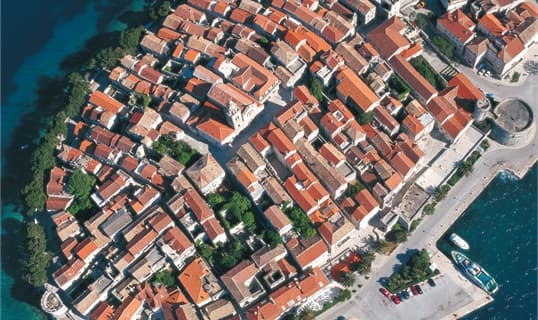
- A town you can walk into from the boat. Korčula Town is a small walled peninsula of stone streets laid out in a herringbone pattern to break the wind. You moor, you step ashore, and you are in it — no taxi, no long walk from an industrial basin.
- Two very different ends of the island. The east end around the old town and Lumbarda is busier and more polished; the west end around Vela Luka is working, quieter and much less visited by charter crews.
- Wine you can actually taste where it is grown. Pošip from the villages of Čara and Smokvica, and Grk from the sandy vineyards around Lumbarda, are both worth a lunch stop rather than a supermarket bottle.
Main Harbours – Korčula Town, Lumbarda & Vela Luka
You will normally spend a night in one of these three.
- Korčula Town: The obvious choice, and the busiest. There are marina berths and town moorings close to the walls, with restaurants, bars and provisioning all within a few minutes on foot. In July and August it is worth arriving earlier in the afternoon or arranging a berth in advance.
- Lumbarda: A short hop east of the old town, calmer and more spread out, with sandy beaches nearby and the Grk vineyards behind. A good alternative if you want the town without sleeping in the middle of it — it is a short taxi ride away.
- Vela Luka: At the far west end, in a long, deeply indented bay that offers real shelter in most conditions. It is a proper town rather than a resort, and it suits crews arriving from Vis or heading north who do not want to commit to the eastern end.
Smaller options worth knowing: Račišće on the north coast, and the sheltered coves around Badija and Vrnik just east of the old town, which make a good swimming stop or a quiet night at anchor when the town is full.
Quiet Bays & Anchorages Around the Island
The south coast is where Korčula gets interesting once the boat is yours for the afternoon. It is more exposed than the north, so it works best in settled summer weather, but it rewards you with a string of coves that see a fraction of the traffic the old town does.
- Bays around Brna and Zavalatica offer shelter and a small-village feel.
- The islets off the eastern tip — Badija, Vrnik and their neighbours — are a classic lunch stop, easy to reach and easy to leave.
- The north coast between Račišće and Korčula Town has several small inlets that suit a lunch anchorage more than an overnight.
As always in the Adriatic, choose your overnight anchorage for the forecast rather than the photograph. Our best anchorages in Croatia guide covers how to think about that in general terms.
One-Week Routes Including Korčula
Korčula fits naturally into a week from either end of Dalmatia:
- From Split or Trogir: Šolta or Brač → Hvar → Korčula → Šćedro or back towards Hvar → Brač → home. This gives you one long southern leg and a very varied week.
- From Dubrovnik: Elaphiti islands → Mljet → Korčula → Šipan or Lopud → Dubrovnik. Shorter legs, more time ashore, and two of the best towns in the south.
- With a skipper and an early start: adding Lastovo between Korčula and Vis turns the same week into something noticeably quieter.
If you want more variations, the best sailing routes in Croatia guide and our itinerary library go into more detail.
Korčula's legs
| Leg | Distance | Under sail |
|---|---|---|
| Hvar Town → Korčula Town | 33 nm | 5 h 30 m |
| Vis → Korčula Town | 42 nm | 7 h |
| Split → Korčula Town (direct) | 50 nm | 8 h 20 m |
| Dubrovnik → Korčula Town | 45 nm | 7 h 30 m |
| Korčula → Mljet (Polače) | 22 nm | 3 h 40 m |
| Korčula Town → Lumbarda | 4 nm | 40 min |
Times at 6 knots. Korčula sits almost exactly halfway between Split and Dubrovnik, which is why it appears on routes from both — and why it is the natural mid-point of a one-way fortnight.
Two-Week Trips Linking Korčula With Other Regions
With two weeks you can stop treating Korčula as a waypoint. A common shape is Split → Brač → Hvar → Vis → Lastovo → Korčula → Mljet → Dubrovnik and back along the outside of the islands, which lets you see the same coast twice from two different angles without repeating a single anchorage.
One-way Split–Dubrovnik routes also make Korčula an easy overnight rather than a long day's target. A one-way charter (say Split to Dubrovnik) is possible only if the charter company allows it, usually for a one-way fee — ask us.
Wind, Weather & When to Visit Korčula
Summer here follows the usual Adriatic pattern: mornings light, an afternoon maestral from the north-west building through the day, and calm evenings. The Pelješac Channel accelerates that breeze, which is good for sailing and worth planning around for mooring.
The bura from the north-east arrives with cold, gusty air and excellent visibility; the jugo from the south-east brings cloud, swell and a longer, wetter sea. On Korčula the practical difference is which coast you want to be on — the north coast shelters you from the south, and the south coast from the north.
June and September are the sweet spot: warm water, working restaurants, and noticeably fewer boats than the middle of August. Our weather by month page has the seasonal detail.
Choosing the Right Boat for Korčula
- Catamarans: Comfortable at anchor and shallow enough for the southern bays, which is where a catamaran earns its money here. See typical models on the Catamarans page.
- Sailboats: The legs to and from Korčula are long enough to be proper sailing rather than motoring between islands. Browse the Sailboats overview.
- Motor yachts & power catamarans: Worth considering if you want Korčula, Mljet and Lastovo in the same week without long days. See motor yachts and power catamarans.
When you use the Boat Search or look through the fleet we charter, and when you ask for a quote, pick the Split or Dubrovnik area — Korčula sits halfway between the two, so either makes it comfortable rather than rushed.
Life Ashore – Old Town, Wine & Evenings
Korčula Town is small enough to see in an evening and good enough to come back to. The cathedral, the narrow side streets and the walls above the water are the obvious draw; the quieter pleasure is walking the outside of the peninsula after dinner while the boats settle for the night.
Food is southern Dalmatian: fish, olive oil, lamb from Pelješac, and the island's own white wines. Lumbarda is the place for Grk and a sandy beach afternoon; Čara and Smokvica, inland, are the Pošip villages and make a good half-day if you want to see the island away from the water.
Evenings are lively without being loud. There are cocktail bars built into the old towers and a few late spots, but the general rhythm is dinner, a walk and a drink rather than a night out.
Practical Tips for Visiting Korčula by Yacht
- Arrive at the old town earlier in the afternoon in peak season, or book ahead — the berths closest to the walls fill first.
- Check the forecast for the Pelješac Channel specifically, not just the general area.
- If the town is full or the wind is wrong, Lumbarda and the Badija coves are close, easy alternatives.
- Keep a half-day for the west end if your route allows it; Vela Luka is a different island from the postcard.
- Provisioning is straightforward in Korčula Town and Vela Luka; smaller villages carry basics only.
FAQ – Korčula for Charter Crews
Is Korčula suitable for a first sailing holiday?
Yes, particularly with a skipper on board. The harbours are well-marked, the distances between stops are reasonable, and there is almost always a sheltered alternative nearby. For bareboat crews it is a comfortable target once you are used to reading the forecast for a channel.
How many nights should we spend on Korčula?
One or two on a one-week route — typically a night in or beside the old town, and a second either in a bay or at the western end. On a two-week trip, many crews come back a second time from a different direction.
Can we moor right next to the old town?
There are marina berths and town moorings close to the walls, which is exactly why Korčula Town is so popular. In July and August they go early, so plan the arrival rather than drifting in at seven in the evening.
Is Korčula better from Split or from Dubrovnik?
Both work. From Split it is a longer reach and usually the southern highlight of the week; from Dubrovnik it pairs naturally with Mljet and the Elaphiti islands. If Korčula is the main reason for the trip, starting in the south gives you more time on it.
How do we start planning a charter that includes Korčula?
Use the Boat Search to filter boats and dates, or send us a short message through Get a Quote describing your crew and what you want the week to feel like. Within minutes you get the boats that fit, each checked live, followed by an email with four sample routes; reply and a person answers.


