
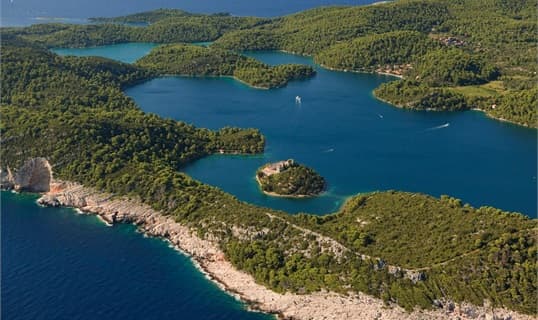
Mljet is the green one. Long, narrow and heavily forested, it runs along the coast west of Dubrovnik, and its western third is a national park built around two connected saltwater lakes. For a charter crew it offers something rare: an island where the best day is spent walking and swimming rather than sailing.
This guide looks at Mljet as a stop on a real route — how it fits a week from Dubrovnik or Split, which of its bays work for a night, and what the national park means when you arrive by boat. For broader planning, see the Destinations hub or the Croatia itineraries section.
Where Mljet Sits on Your Croatia Sailing Map
Mljet lies between Korčula and Dubrovnik, roughly parallel to the Pelješac peninsula. From Dubrovnik it is a comfortable day's sail — often a first or second-day stop. From Korčula it is a comfortable half-day. From Split it is a genuine southern target, usually reached on day three or four via Hvar and Korčula.
Because it is long and thin, where you approach matters. The national park and its harbours are at the western end; the middle and eastern parts of the island are quieter and much less visited, with a handful of small bays that suit crews who want to be alone.
Why Mljet Is Worth a Day, Not Just a Night
Most Croatian islands are about the water. Mljet is about what is behind it.
- The lakes. Veliko Jezero and Malo Jezero are two connected saltwater lakes inside the national park, ringed by pine forest and linked to the sea by a narrow channel. You can swim, walk or cycle around them on good paths.
- The monastery island. In the middle of the Great Lake sits a small island with a 12th-century Benedictine monastery on it, reached by a short boat transfer. It is the picture most people have seen of Mljet without knowing where it was.
- Real shelter. Polače is one of the best-protected bays in the Adriatic. That is worth knowing on a week when the forecast turns.
Main Harbours – Polače, Pomena, Sobra & Okuklje
- Polače: A large, deeply sheltered bay at the north-west end, with Roman ruins on the shore and restaurants that lay mooring lines for guests. It is the usual choice for the national park, and the shelter is genuine rather than nominal.
- Pomena: On the western tip, closer to the park entrance and the lakes, smaller and more exposed than Polače but very convenient if the lakes are your reason for coming.
- Sobra: The ferry port in the middle of the island. Practical, with connections and basic supplies, and rarely a destination in itself.
- Okuklje: A small, well-protected inlet on the north coast, east of Sobra, with a couple of restaurants and mooring lines. A good, quiet overnight if you are heading east towards Dubrovnik.
Between Sobra and Okuklje, Prožurska Luka is another sheltered option, and the sandy bays around Saplunara at the far eastern tip are among the few genuinely sandy beaches in this part of Croatia.
Mljet National Park – What It Means Arriving by Boat
The park covers the western end of the island, including the lakes and the water around Polače and Pomena. Arriving by yacht, the practical points are:
- There is an entrance ticket, and mooring or anchoring in the park area is normally tied to it. Restaurants and mooring operators will explain the current arrangement when you arrive.
- Boat traffic inside the lakes is restricted — you visit them on foot, by bicycle or on the small park transfer boat, not in your charter yacht.
- Bicycles are the best way to see it. You can hire them near the harbours, and the ride around the Great Lake is easy and genuinely lovely.
Give it most of a day. Arriving at six in the evening and leaving at nine the next morning is the most common Mljet mistake.
One-Week Routes Including Mljet
- From Dubrovnik: Elaphiti islands → Mljet (two nights) → Korčula → Šipan or Lopud → Dubrovnik. Short legs, a lot ashore, and the easiest way to give the park a proper day.
- From Split or Trogir: Brač or Šolta → Hvar → Korčula → Mljet → Korčula → Hvar → home. A longer week with one real southern push.
- With more sailing appetite: add Lastovo between Korčula and Mljet for a much quieter middle to the week.
See the best sailing routes in Croatia guide for more shapes.
Mljet's legs
| Leg | Distance | Under sail |
|---|---|---|
| Dubrovnik → Polače | 30 nm | 5 h |
| Šipan → Polače | 20 nm | 3 h 20 m |
| Polače → Korčula Town | 22 nm | 3 h 40 m |
| Polače → Pomena (along the north-west coast) | 5 nm | 50 min |
| Mljet → Lastovo | 24 nm | 4 h |
| Split → Polače (direct) | 70 nm | 11 h 40 m |
Times at 6 knots. Polače is the reason Mljet appears on every southern route: it is almost landlocked, which makes it the best all-weather shelter in southern Croatia — and the first place to fill when a Jugo is forecast.
Two-Week Trips Linking Mljet With Other Regions
Two weeks lets you treat Mljet as a rest point rather than a checkbox. A comfortable pattern is Split → Brač → Hvar → Vis → Lastovo → Korčula → Mljet → Elaphiti → Dubrovnik, then back along the mainland side. Many crews put two nights on Mljet on the outbound leg and one on the way home, using Polače as a weather refuge if the forecast asks for it.
One-way Split–Dubrovnik charters suit Mljet particularly well, since it sits naturally near the end of the route. A one-way charter (say Split to Dubrovnik) is possible only if the charter company allows it, usually for a one-way fee — ask us.
Wind, Weather & When to Visit Mljet
The island runs roughly north-west to south-east, so it shelters one coast or the other in most conditions. Polače is the standout — deeply indented and protected from almost every direction, which is why it is a common choice when the weather is unsettled.
Summer follows the normal pattern: light mornings, an afternoon maestral from the north-west, calm evenings. The jugo from the south-east makes the southern bays uncomfortable and sends most crews to Polače; the bura from the north-east is gusty but usually short-lived this far south.
The forest keeps Mljet noticeably greener and a little cooler than the bare islands further north, which is a real comfort in August. Weather by month has the seasonal detail.
Choosing the Right Boat for Mljet
- Catamarans: Comfortable at anchor and stable for families, and the shallow draft helps in the smaller eastern bays. See the Catamarans page.
- Sailboats: The legs between Dubrovnik, Mljet and Korčula are pleasant sailing rather than long crossings, which suits a monohull well. See the Sailboats overview.
- Motor yachts & power catamarans: Let you combine Mljet with Lastovo and Korčula comfortably inside a week. See motor yachts and power catamarans.
Mljet also suits a skippered charter particularly well, because the best version of the day is the one where nobody is thinking about the boat.
Life Ashore – Forest, Lakes & Quiet Evenings
Mljet is not a nightlife island and does not pretend to be. Evenings are dinner on the waterfront at Polače or Okuklje, a walk, and an early start for the lakes.
The food is good and unfussy — fish, lamb, local olive oil and wine, often from the family that runs the restaurant. Away from the park, the villages along the island's spine are small and largely agricultural, and the roads through the pine forest are quiet enough to cycle.
If you want one memory from the island, it is usually the same one: swimming in the Great Lake in the early morning, with the monastery island a few hundred metres away and nobody else in the water.
Practical Tips for Visiting Mljet by Yacht
- Plan two nights if the national park is a reason for the trip; one night is not enough for the lakes.
- Arrive at Polače in good time in high season — the mooring lines go to guests who book dinner, and they fill.
- Hire bicycles rather than walking the whole lake circuit, especially with children.
- Buy the park ticket properly; checks do happen, and the fee is what maintains the paths.
- Provision in Korčula or Dubrovnik. Village shops on Mljet carry basics only.
- If the jugo is forecast, Polače is the answer — it is one of the safest bays in southern Dalmatia.
FAQ – Mljet for Charter Crews
Is Mljet good for families with children?
It is one of the best islands in Croatia for them. The lakes are warm, calm and safe for swimming, the cycling is flat and easy, and Polače is sheltered enough that nobody is woken by swell. Our 7-day Dubrovnik route shows how it fits a week.
Can we sail our yacht into the lakes?
No. The lakes are inside the national park and closed to charter yachts. You moor or anchor in Polače or Pomena and reach the lakes on foot, by bicycle or on the park's own transfer boat.
How many nights should we spend on Mljet?
Two, if the park matters to you — one to arrive and eat, one to give the lakes a full day. On a fast route, a single night in Okuklje or Polače still makes a pleasant stop, but you will not really have seen the island.
Is Mljet expensive to visit?
There is the national park ticket on top of your normal mooring and dinner costs. It is a modest amount for what it protects. Our full cost guide covers how park fees, moorings and extras add up over a week.
How do we start planning a charter that includes Mljet?
Use the Boat Search to check boats and dates, or send us a short brief through Get a Quote. Pick the Dubrovnik area if the national park is the point of the trip, or the Split area if it is a stop along the way — the base changes which routes fit.


